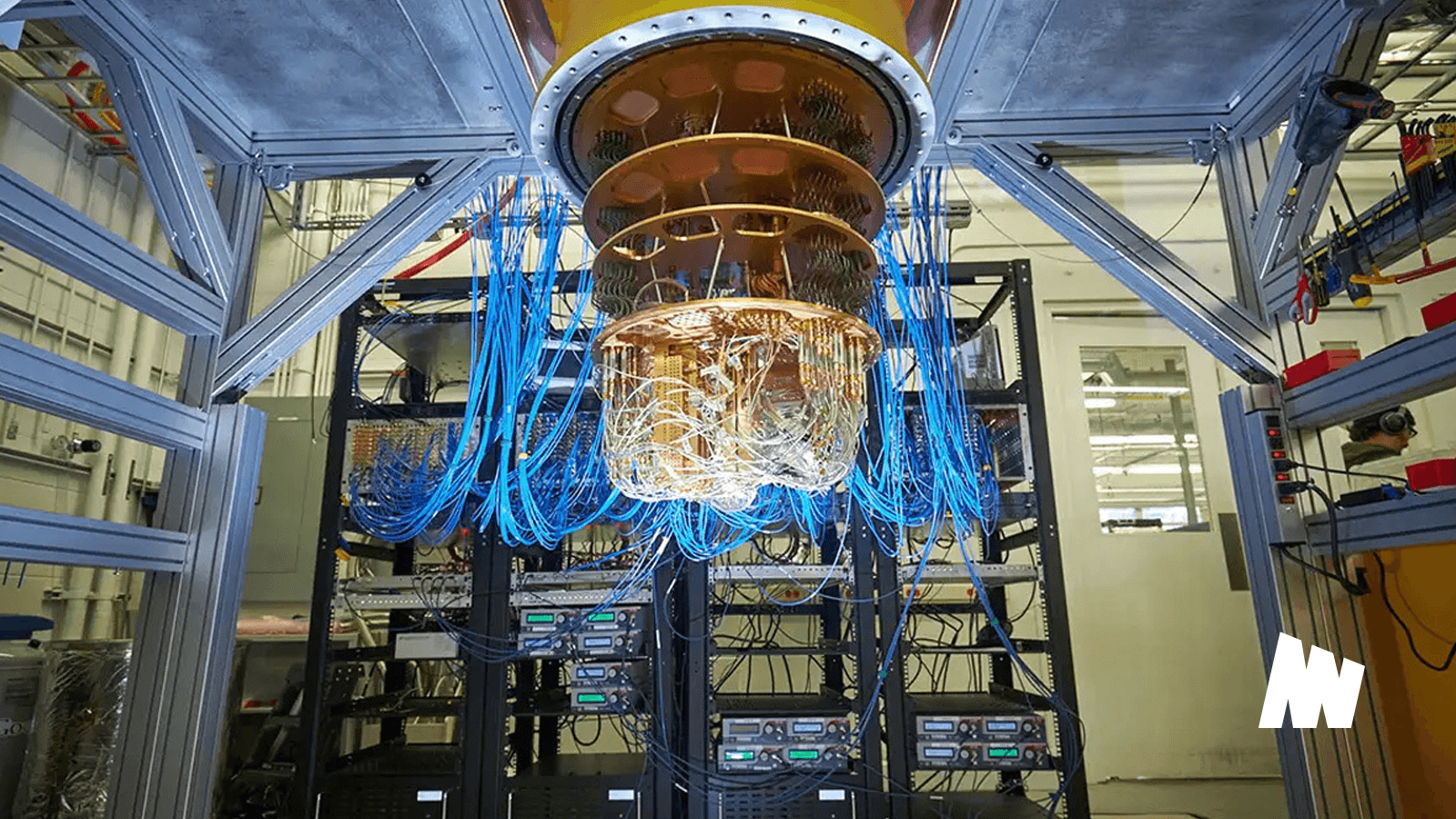
For years, quantum computing has been treated as a distant concern for the blockchain industry: a theoretical risk, comfortably parked somewhere beyond the next market cycle.
That assumption is no longer safe.
Recent research from Google has materially shifted the conversation. The resources required to break widely used cryptographic schemes, including those underpinning much of today’s blockchain infrastructure, may be significantly lower than previously believed.
This is not a prediction of imminent collapse, but it is a warning:
The window to prepare for the quantum era is shrinking… fast.
The Industry Is Solving the Wrong Problem
In response, a growing number of projects are positioning themselves as “quantum-resistant.”
On the surface, this sounds reassuring. In reality, it may be dangerously incomplete.
Most of these systems take a straightforward approach: replace classical cryptography with a post-quantum alternative, embedding a specific scheme directly into the protocol. Projects like Mochimo have taken early steps in this direction, adopting quantum-resistant primitives at the base layer.
That’s a meaningful evolution, but it rests on a critical assumption:
That the post-quantum algorithms we choose today will still be the right ones tomorrow.
History suggests otherwise.
Post-Quantum Cryptography Is Not Finished
The transition to post-quantum cryptography is not a single upgrade, it is an ongoing process.
Standards are still emerging, trade-offs are still being discovered. New attack vectors will inevitably surface.
Even National Institute of Standards and Technology (NIST), which is leading global standardisation efforts, continues to evaluate and refine candidate algorithms.
And critically, guidance from organisations like Google increasingly emphasises a concept the blockchain space has largely overlooked:
The ability to adapt cryptography over time.
Because in a post-quantum world, nothing stays final for long.
Static Security Is Already Obsolete
Here’s the uncomfortable truth: A blockchain that is “quantum-resistant” because it uses a specific algorithm is still making a static bet on a moving target.
That isn’t future-proofing. No - that’s just moving the point of failure.
If a vulnerability is discovered - or a better standard emerges - what happens next?
- Can the network upgrade quickly?
- Can it coordinate globally without fragmentation?
- Can it do so without sacrificing decentralisation?
For most architectures, the honest answer is: not easily.
And in a compressed timeline, “not easily” quickly becomes “not in time.”
The real divide then, is Static vs Adaptive Architectures. The quantum era won’t be defined by which chain picked the “right” algorithm first. It will be defined by which systems were designed to adapt continuously.
This is where the conversation needs to shift, because quantum resistance is not a feature, it’s a capability over time.
Why Minima Was Built for What Comes Next
Minima approaches this problem from a fundamentally different direction.
At the protocol level, Minima already utilises hash-based cryptography, specifically WOTS (Winternitz One-Time Signatures) combined with SHA3 hashing. This avoids reliance on eliptic curve systems that are widely considered vulnerable in a post-quantum context. But its advantage doesn’t stop at what it uses today. It extends how it evolves tomorrow.
-
Evolution Without Disruption: Unlike many blockchains, Minima is not designed around periodic, high-risk hard forks to introduce fundamental changes. Instead, its architecture allows new cryptographic approaches to be introduced at the transaction and application layer, enabling users and developers to progressively adopt stronger security models over time. Security doesn’t rely on a single, irreversible choice, it evolves through usage.
-
A Network That Can Actually Move Together: Security upgrades are not just technical challenges - they are coordination challenges. Minima’s architecture, where every user runs a full node, creates a uniquely distributed yet synchronised network. This matters, because in a moment of cryptographic urgency, the ability to move together is as important as the solution itself.
-
Resilient by Design: Post-quantum cryptography introduces real-world constraints: larger signatures, increased computational overhead, and more complex verification. Minima’s lightweight design helps absorb these pressures, ensuring that stronger cryptography does not come at the cost of accessibility or decentralisation.
-
Built for an Uncertain Future: Most importantly of all, Minima is not built around a single vision of the post-quantum world. It is built for the reality that the post-quantum world will change.
What Question Should Industry Be Asking?
The conversation needs to move beyond “Is this blockchain quantum-resistant?”, toward something far more important.
“How does this blockchain evolve when its current cryptography is no longer enough?”
Because that moment will come and when it does, the difference between systems will be stark.
The blockchain industry has navigated volatility, regulation, and technological shifts before.
But quantum computing is different. It does not degrade systems gradually. It breaks assumptions, suddenly and decisively. The latest signals from Google are clear:
The timeline is tightening. The margin for error is shrinking.
In most blockchains, security upgrades are events. In Minima, they are a process.
And in a world where the foundations of digital security are being rewritten in real time, that distinction is everything. Minima is not just quantum-resistant… It is quantum-ready.