For years, the assumption has been simple
If you want to run a blockchain, you do it in the cloud.
That assumption is starting to break.
A recent post from Arm’s Semiconductor Education Alliance looked at a project with the University of Southampton, Siemens, and Minima. The brief was straightforward on paper, but difficult in practice:
What does it actually take to run a blockchain on a chip?
Not a simulation, not a cut-down model. A real protocol - on real hardware.
This Is Where It Gets Interesting
The team didn’t work with a toy problem.
They took a live Minima node - the same protocol that runs today - and forced it into an environment most blockchains simply aren’t designed for:
Constrained, embedded Arm hardware.
That meant rewriting parts of the stack (Java to C++), introducing hardware-accelerated SHA3, and making hard decisions about performance, energy, and system design.
And it worked.
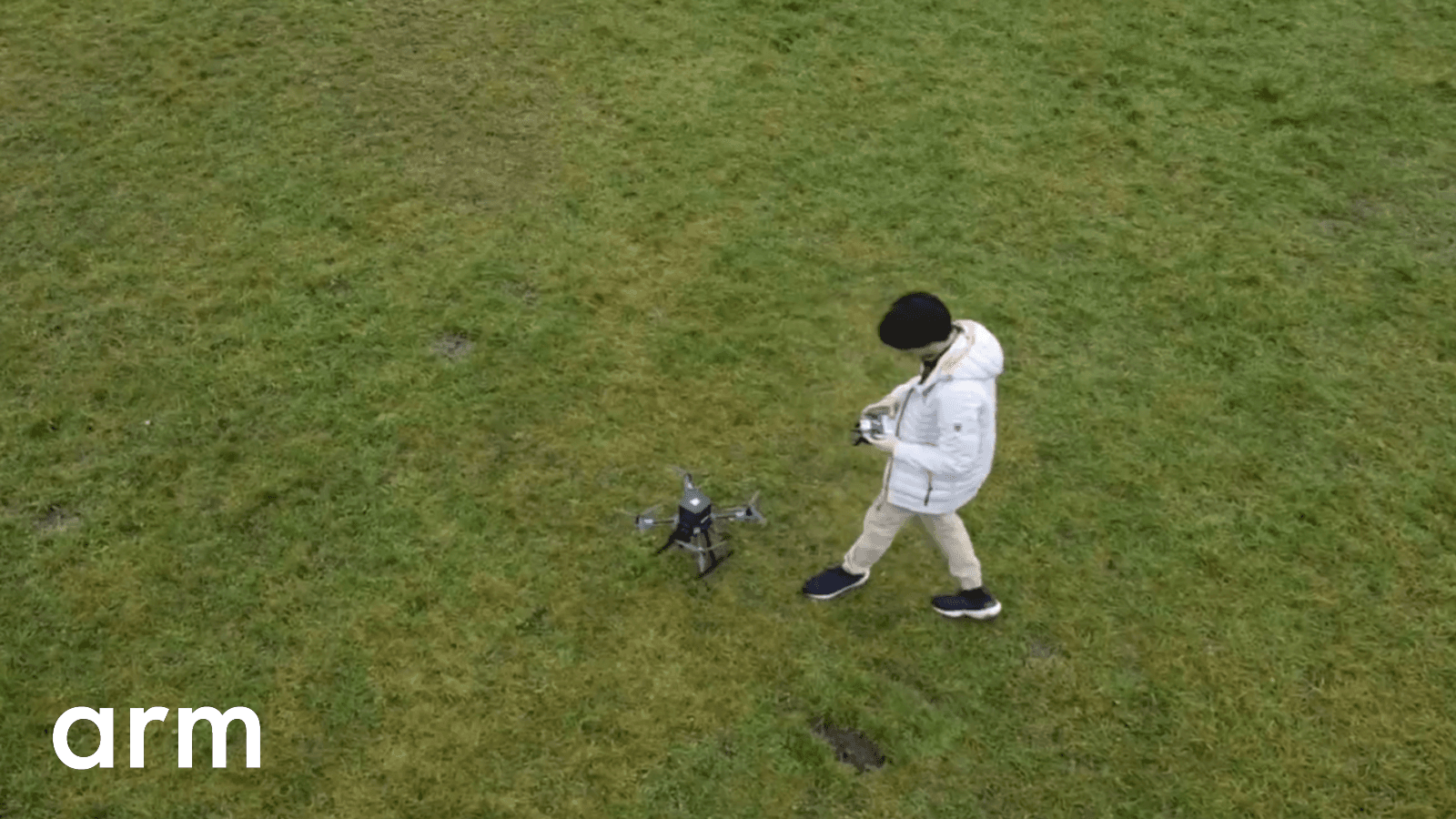
A full node, running on embedded hardware, validating real data. In this case, drone telemetry written and verified on-chain.
No cloud dependency. No external crutch.
Just the system, doing what it’s supposed to do.
There will be some who will read this as a University project
Be careful to not sell these engineers short... it isn’t, it’s a preview.
Because the real shift here isn’t “blockchain on a drone” or even “blockchain on embedded hardware”.
It’s this:
Blockchain is moving to the edge.
And once that happens, a lot of assumptions fall apart.
- You don’t need to trust a central server.
- You don’t need to rely on post-event data reconciliation.
- You don’t need to ask a machine what it did and hope the logs are accurate.
The machine can prove it.
This Is Blockchain-on-Chip
We’ve been using the term Blockchain-on-Chip internally for a while now.
Not as a slogan, but because there isn’t really a better way to describe what’s happening.
You’re taking blockchain capability - validation, consensus, cryptographic integrity - and embedding it directly into the device.
Not above it, not alongside it. Inside it.
That changes the model completely.
Now the point of trust isn’t a server somewhere, it’s the machine itself.
Arm Gets It
What’s notable about the Arm write-up isn’t just the technical detail, although that’s there. It’s that they framed it properly.
This wasn’t treated as a novelty or a marketing exercise. It was approached as a systems problem:
- How do you balance software vs hardware acceleration?
- What happens to performance under real constraints?
- Where do you draw the line between protocol design and silicon?
These are the right questions.
Because this is where things are going.
The Bigger Picture
We’re heading into a world where:
- Autonomous systems make decisions without human oversight
- AI workloads run locally, not centrally
- Machines interact with each other directly
In that world, trust becomes a systems-level requirement, not a feature you bolt on afterwards.
And the only way that works is if machines can:
prove what they did, independently
Not report it. Not approximate it. Prove it.
What Comes Next
This project got a full node running on embedded hardware and that’s just the first step.
The next steps are harder, and more interesting:
- Pushing efficiency further down into silicon
- Standardising how these systems are deployed
- Moving from prototypes to production environments
That’s where this goes from “interesting” to “inevitable”.
Where Minima Sits in This
Minima was designed with this end state in mind.
Not for trading. Not for speculation.
For running at the edge, on devices that don’t have the luxury of unlimited compute or constant connectivity.
Seeing it run in this environment, under real constraints, with real engineering trade-offs, is exactly the kind of validation that matters.
Not headlines or hype.
Reality.